A chronology of the 14-year campaign to build a bypass around Bridge and confront the hazards on Kent’s “death highway” (1962-76)
The 1960s and 70s was a time of political, social and economic change in Britain that saw a rapid growth in private car ownership, the development of a national motorway network and a drastic cut in rail services, radically altering how people and goods moved around. The country shifted closer to continental Europe, creating new challenges for the development of transport infrastructure, in particular whether or not to build a fixed link across the Channel to France.
The medieval village of Bridge, located on the main London-Dover highway, was at the epicentre of these changes, with an ever-increasing number of passenger and freight vehicles thundering along the narrow High Street, gaining speed on the downhill approaches to the village.
Villagers had long-complained about the dangers they faced by simply stepping out their front door, but when 66-year-old George Smith died after being knocked down by a van on the High Street in January 1962, complaints turned to action.
John Purchese, a local sound recordist and printer, began a letter-writing campaign urging government officials to include a Bridge bypass in plans to develop the M2, already under construction around the Medway towns. The campaign quickly gained momentum and by September 1962, a total of 564 residents had signed a petition calling for the construction of a bypass. The following year, 20-year-old Brian Lewis, who had narrowly avoided an accident himself, organised a march of 50 young people through the village in support of the bypass. He then joined John as co-chair of the campaign, and the two men worked together leading the movement for the next decade.
On Easter Sunday, 1964, 150 villagers held a protest march carrying a coffin and a wrecked vehicle along the High Street to commemorate the reported eight dead and 50 injured over the previous five years.
In June, Transport Minister Ernest Marples decided that the M2 would terminate at Brenley Corner, outside Faversham. He argued that there was no need to extend the motorway all the way to Dover because the governments of the United Kingdom and France had signed an “agreement in principle” to build a Channel Tunnel that would divert traffic away from the port.
The Bridge bypass campaign responded by expanding its reach to cover all the villages along the 22-mile stretch of the A2 from Brenley Corner to Dover. The renamed A2 Group distributed leaflets to the 1,600 households directly facing onto the highway, while villagers in Bridge carried a bed with an effigy of Marples, “asleep at the wheel” along the High Street in protest at his lack of action.
The protest was not appreciated by Canterbury MP, Leslie Thomas, who branded the agitators “undemocratic” and urged villagers to “keep a sense of proportion.”
The following year, the government announced a £500,000 plan to widen the A2 in parts but a bypass for Bridge was not included in the scheme. Official government policy was to “progressively improve the A2 trunk road.” In reality, the approach of planners was haphazard and disjointed, focusing on discrete projects along the route rather than developing a comprehensive scheme. John Purchese urged the Ministry of Transport to prioritise the construction of bypasses around Boughton, Harbledown, Bridge and Lydden over the widening of rural stretches in between them – the opposite of what actually happened.
In August 1965, six people were injured in a ten-vehicle pile-up in Bridge, briefly re-energising demands for a bypass but the campaign gradually ran out of steam due to frustration with government officials and a growing sense of apathy in the villages.
However, by 1969, the residents of villages along the A2 had reached their breaking point. Many of the container trucks coming through Dover under the Transit International Routier (TIR) Convention, which went into effect in 1960, were dangerously overloaded or poorly maintained, and there were frequent accidents along the A2. Villagers were concerned that foreign drivers were unfamiliar with driving on narrow English roads, and did not understand road signs and hazard warnings.
In August 1969, around one hundred villagers staged a sit-down protest in Bridge, leading to four arrests.
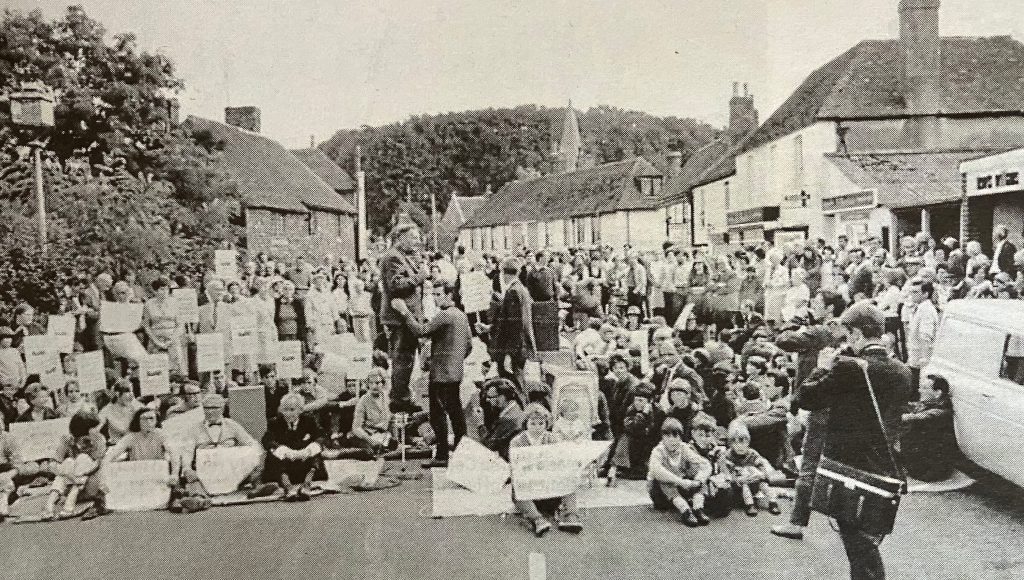
A week later, the residents of Boughton (which had an equally narrow and congested high street) organised another protest. There was still no positive response from the government.
Then, in May 1972, a container lorry heading for Switzerland demolished the front of Colin Lewis’ shop at 90/92 High Street.
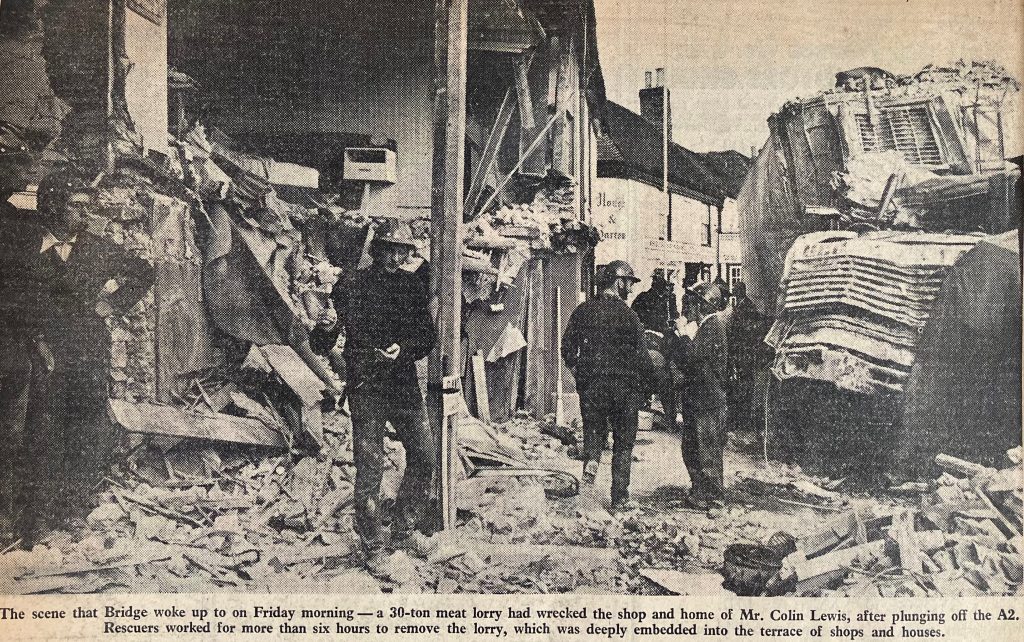
Two days later, around 300 villagers blocked the road for an hour in protest. Campaigners erected a billboard on the side of the damaged building demanding: “Ban TIR Now – By-pass Bridge.”
On 23 June, about 300 people attended a meeting at the County Hotel in Canterbury to demand action on A2 safety improvements and formally relaunch the A2 Group. The angry meeting confronted the head of the Kent County Council (KCC) Highways Committee and vowed to form a commando squad that would take “whatever action necessary” to force the government to extend the M2 to Dover.
The campaign received support from David Crouch, who had succeeded Leslie Thomas as a more sympathetic MP for Canterbury in 1966. By August, the reinvigorated campaign was making national headlines. The Daily Mail screamed: “The Juggernaut invaders which threaten Britain’s heritage” above a photo of a lorry passing by the church on the High Street, and a caption: “Thundering through: The lovely village of Bridge in Kent… and one of the monsters that invade it.”
In September, Roads Minister Graham Page was met by banner waving protestors in Boughton, Harbledown and Bridge when he took a coach trip along the A2 to inspect conditions for himself.
Brian Lewis promised more action, and on 21 October, the movement reached a new highpoint when up to a thousand villagers blocked the High Street in Bridge.
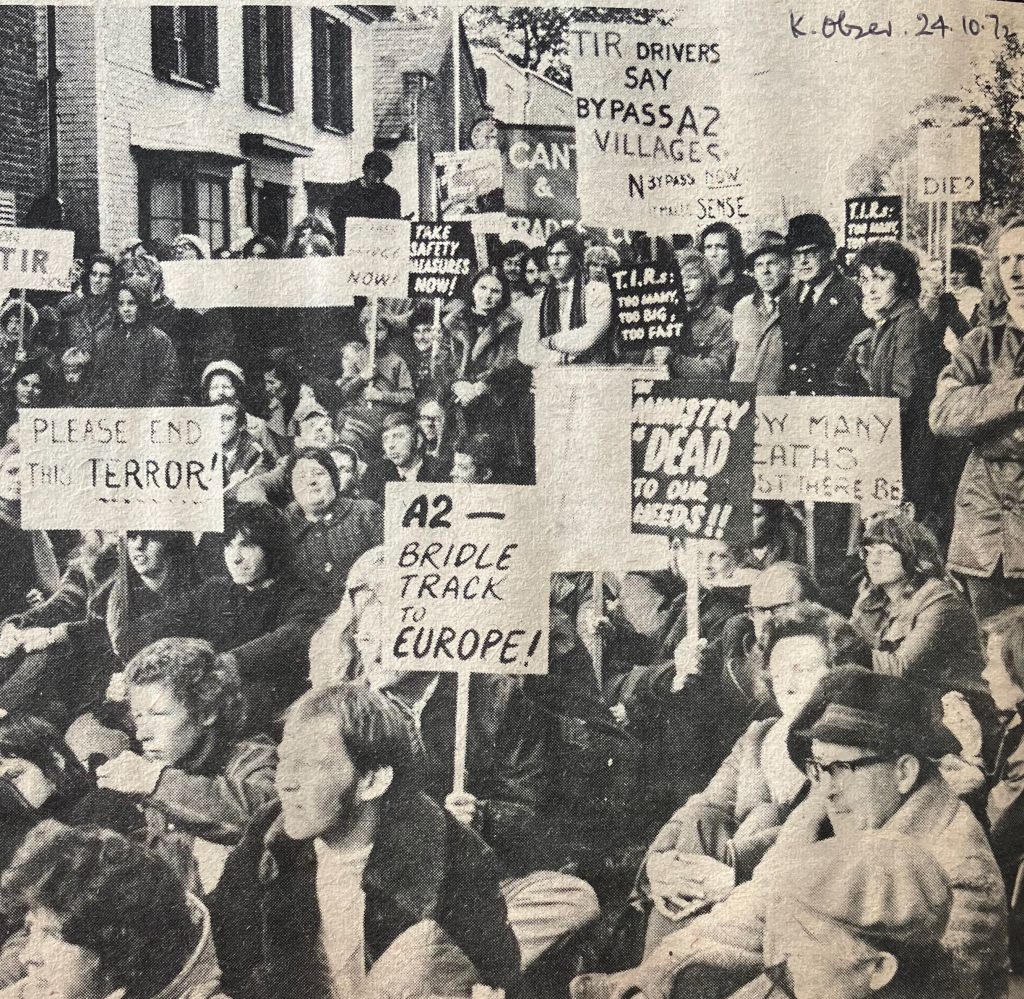
Around 50 police officers were present and warned protestors that they would be arrested if they refused to leave. The protests moved to Bridge Place where David Crouch (who had cautioned against illegal protests) gave a speech in support of the campaign. John Purchese and Brian Lewis were charged with conspiring to block the highway. No further action was taken at the time but they were warned that, if the offence was repeated, the matter would be looked at again.
In November, the government published its proposed bypass route to the north of Bridge. The parish council voted in favour of the scheme but objections from some residents forced a full public inquiry.
Meanwhile, the campaign turned its attention to France. John Purchese wrote to the editor of Le Monde pointing out that beautiful villages on the route from Dover were being damaged by heavy goods vehicles from Europe.
New road signs were erected on the approaches to Bridge “Road Narrows” and “Reduce Speed Now” but the A2 Group demanded more. In December, it distributed several thousand Christmas cards to those in power calling for a 20mph speed limit in all A2 villages, rigorous checks on TIRs and greater resources devoted to the police to enforce traffic rules. The same month, there were two accidents at the junction of the High Street and Patrixbourne Road.
On 1 January 1973, Britain formally joined the European Economic Community opening the gates for even more freight traffic to pass through the port of Dover and the villages along the A2.
Additional traffic calming measures were introduced in Bridge, including 40mph speed limits on the approaches to the village and a pelican crossing in the High Street. After a long stand-off with the local council, the protest sign covering Colin Lewis’ damaged property was taken down, but the A2 Group demanded that Colin be properly compensated for his loss.
A three-day public inquiry into the bypass was held at Bridge Place in May, during which the A2 Group was represented pro bono by a solicitor from Furley Page. Some residents called for the bypass to be routed on the southern side of the village.
In June, three soldiers were killed when a juggernaut hit their car in Dover, further highlighting the dangers faced by motorists as well as pedestrians on the A2. Responding to the tragedy, David Crouch and Peter Rees, MP for Dover, forced a debate in the House of Commons during which the Under-Secretary of State for the Environment, Keith Speed, reported that work on the Bridge bypass could begin in mid-1974, for completion in mid-1976. After the debate, Keith Speed met privately with John Purchese and Brian Lewis in the House of Commons bar.
A week after the debate, a Dutch tanker ran into a line of 13 cars on the downhill approaches to the village. Campaigners continually lobbied Keith Speed for a prompt decision on the bypass, and in August the northern route was confirmed.
A traffic census conducted by the A2 Group in August showed a 12 percent increase in traffic passing through the village.
Campaigners attempted to extend their leafleting to Calais but the British Ambassador to France stated that the traffic problems in the UK were not the problem of France. All attempts to cross the channel were rebuffed but the A2 Group continued to leaflet lorry drivers in Dover.
Yellow bar marks were installed on Bridge Hill in September in a bid to slow traffic, and Brian Lewis asked that similar markings be placed on Town Hill as well.
The government published three options for the Canterbury bypass with Route A passing closest to the city and Route C furthest away. Given that work on the Channel Tunnel was already underway, the government argued that the Canterbury bypass could be a single carriageway highway. The A2 Group favoured the middle Route B with a dual carriageway – the option that was eventually agreed.
In the winter of 1973/74, global events once again impacted Bridge. The oil embargo imposed by Arab members of the Organization of Petroleum Exporting Countries (OPEC) on the allies of Israel, forced the UK government to adopt emergency energy saving measures at the end of December. This meant that the street lights in the High Street were switched off in the dead of winter. On 22 February 1974, a 10-year-old school boy was hit by a car in the dark, and a woman was injured in a separate vehicle collision on the same day.
On 19 March, the Department of the Environment announced the go-ahead for the Bridge bypass with a budget of at least £1.25 million. Later in July, it awarded a £2.3 million contract to Mears Construction for the construction of the Bridge bypass and the widening of the existing A2 to Black Robin Lane.
On 25 May, a lorry crashed into St Peter’s churchyard wall just hours before the Mayor of Canterbury arrived to open the Bridge Flower Festival.
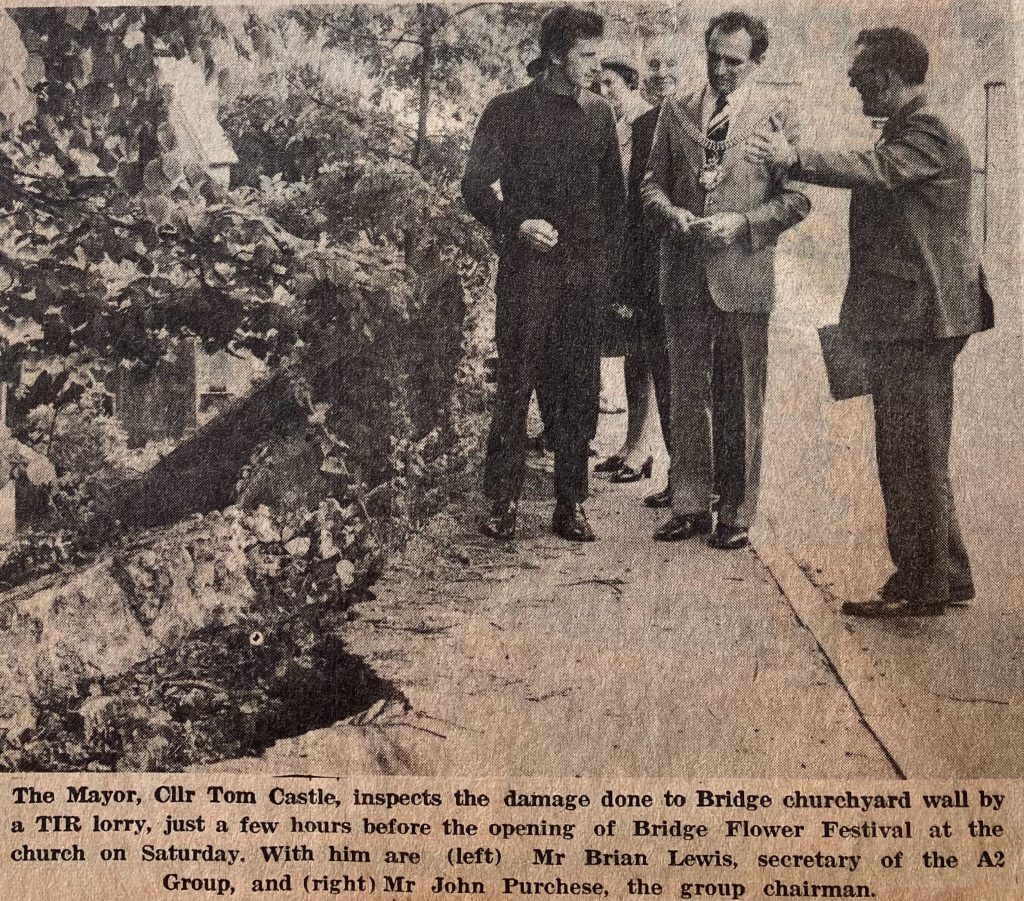
A few weeks later, an elderly motorist died in a crash with a lorry at the Barham crossroads, and a heavy goods vehicle overturned on Church Hill, Harbledown, the third accident at exactly the same spot.
In June, Brian Lewis submitted a design proposal to the Kent County Surveyor for a grade-separated junction to replace the notorious Barham crossroads accident blackspot. Despite constant government pushback on the grounds that such a junction was unnecessary and too expensive, the A2 Group continued to lobby for it, and when, the present interchange was built in 1987, the final design was very similar to the one proposed by Brian 13 years earlier.
After two people (a father and son) were killed in a collision between a lorry and private car on the A2 dual carriageway construction site at the top of Lydden Hill on 8 July, David Crouch tabled a motion to implement a 30mph speed limit on single carriageway sections of the A2. This was quickly rejected.
On 26 September, two elderly women were killed in an accident at the A2 Folkestone turnoff. In response, the A2 Group refocused its attention on the dangers at Barham.
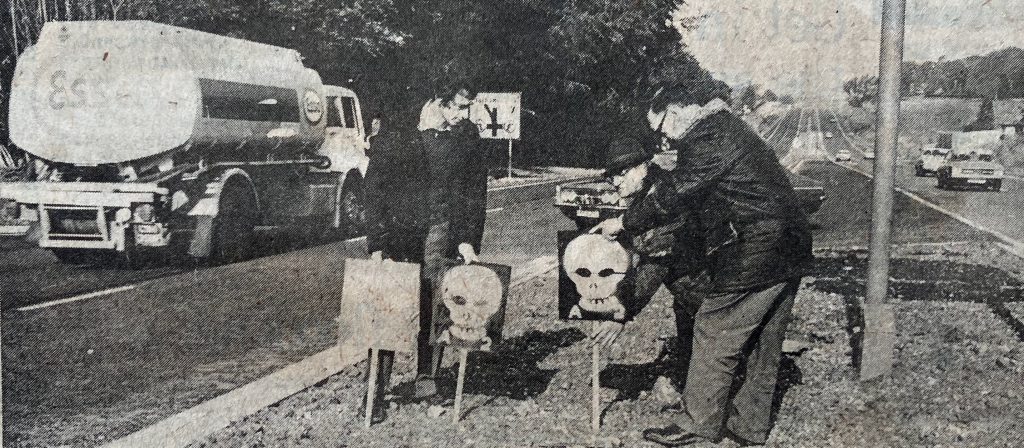
The group placed skull warning signs at the junction. Brian Lewis stated that there had been five deaths on the A2 near Barham in the previous three months, and that KCC would be responsible for manslaughter in the event of more fatalities. The signs were later removed by KCC.
After the Labour government was returned to power with a slight majority in October, there was genuine concern that the expensive Channel Tunnel project would be scrapped, placing an even greater strain on the A2. Campaigners voiced concern that cutbacks in the roads budget would further delay the A2 improvement schedule.
After a surge in the number of accidents on the A2 in early November, David Crouch demanded that Prime Minister Harold Wilson come and inspect the “death road” for himself. On 2 November, a 23-year-old woman had been killed, and three others injured, in a crash just south of Brenley Corner, six days later, a 19-year-old man was killed in an accident half a mile south of the Old Gate Inn, and nine men are injured when their minibus crashed in Harbledown on 16 November.
On Christmas Eve, a two-year-old boy was killed in a four-car accident at Barham crossroads. A week later, Dr Bill Russell of the Bridge Surgery in Green Court was injured in a car crash at the same junction. He told the press, “it is an absolutely maniacal crossroads… Whoever designed it is hopelessly inept and seemed to have no local knowledge.”
In January 1975, David Crouch demanded an urgent inquiry into Barham crossroads, and the A2 Group held a meeting with KCC at which Councillor Laurence Shirley and Dr Russell both demanded action be taken to improve safety.
The following week, the parish councils from Aylesham, Womenswold, Kingston and Barham agreed to join forces with the A2 Group to press for a grade-separated junction at Barham crossroads. On 20 March, Transport Minister, Fred Mulley, told David Crouch that he would arrange an investigation into Barham crossroads. Two days later there was a three-vehicle pile-up at the crossroads involving a police car.
While the focus of the campaign remained on the Barham crossroads throughout much of 1975, the A2 Group also lobbied for a ban on heavy goods vehicles using Old Dover Road (it was alleged that drivers were using the route to avoid weighbridge checks), and in June, Canterbury City Council finally acted to restrict the width of vehicles using the road to 6 feet, six inches.
Campaigners also joined Bridge residents in objecting to a proposed picnic site on Bridge Hill overlooking Bourne Park. The scheme had been approved by Canterbury City Council but was quietly shelved after fervent opposition on the grounds it would bring more traffic to the village just at the point that it had won the battle to build a bypass.
On 5 June, a referendum was held on Britain’s continued membership of the EEC; 67 percent voted in favour. This, together with the official cancellation of the Channel Tunnel in January, meant that the A2 would continue to be the primary artery to the continent for the foreseeable future. Data from the Dover Harbour Board showed a more than 30 percent increase in both passenger and motor vehicle traffic between January and May over the same period in 1974.
The Department of the Environment launched a comprehensive review of the design of the Barham junction. Then, on 20 July, three people died, and eight others injured when a car collided with a coach carrying school children at the crossroads. The A2 Group posted letters to all 15 Kent MPs demanding the immediate closure of the central waiting area to cross-traffic.
On 13 August, eight parish councils held a joint-meeting to lobby for the construction of a grade-separated junction at Barham crossroads rather than the proposed temporary fixes of closing the central reservation and/or installing traffic lights. David Crouch suggested that the EEC should pay for the construction of a grade-separated junction if the UK government could not afford it. At a later meeting with the eight parish councils on 4 September, KCC announced plans to install traffic lights at Barham crossroads as part of a £15,000 “emergency package” of safety measures on the A2.
Within the space of five days in mid-September, a lorry ran into the house at 79 High Street Bridge, owned by Rosemary Williams, a lorry destroyed a butcher’s shop on The Street, Boughton, and Clasina van de Ven, the 20-year-old fiancé of Dutch rallycross champion Cess Teurlings was killed and several others injured in a major accident on the A2 at Lydden Hill, just after Teurlings had won a competition at the race track there.
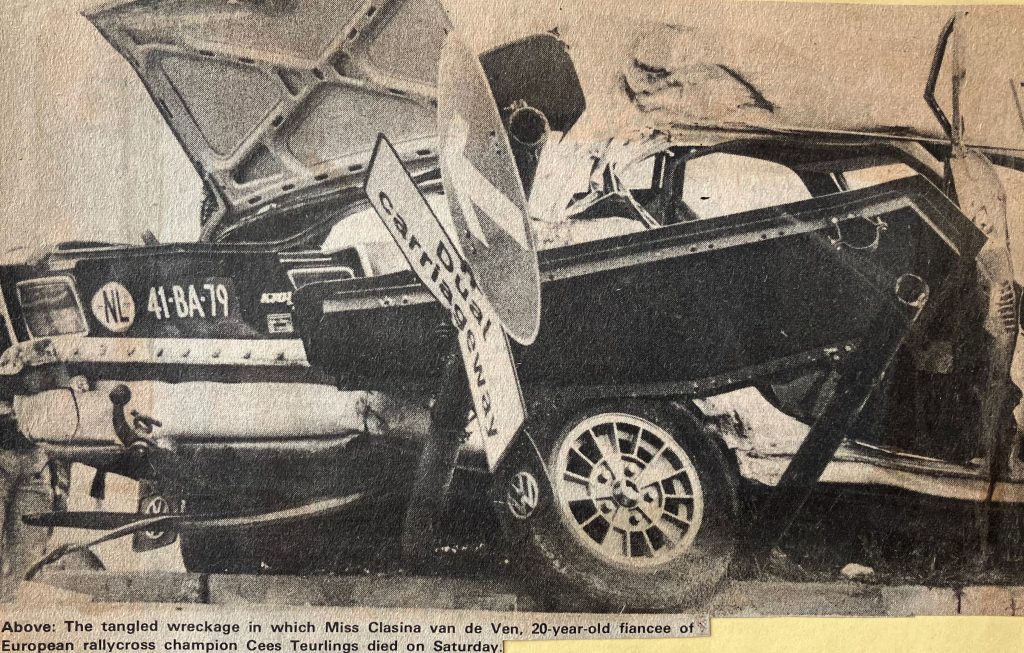
Under pressure from Kent MPs, Under-Secretary of State for the Environment, Neil Carmichael visited Barham crossroads in early October and agreed that it was necessary to install traffic lights there. The lights went into operation on 24 October and almost immediately, Brian Lewis and John Purchese identified defects.
The same day, the Dover Express reported record numbers of passengers using the port of Dover; 6 million in the first 9 months of the year, a 20 percent increase on the same period in 1974 (in the first 9 months of 2025, 7.3 million passengers used the port, showing that traffic levels in the mid-70s were already comparable with today).
In a meeting with the Canterbury Chamber of Trade Traffic Advisory Committee on 10 November, John Purchese proposed a Park and Ride scheme to ease traffic congestion in Canterbury. The idea was dismissed out of hand, and it would take another 16 years before a Park & Ride network was eventually established in the city.
Brian Lewis lobbied Bridge Parish Council to ban TIRs from the village after the bypass opened and extend the 40mph limit beyond the turnoff to Highland Court (a hospital at the time). The parish council eventually agreed to apply for a 6’6” vehicle width restriction in the village once the bypass was operational.
On 2 December, two women were killed and two other passengers were injured when their car collided with a lorry on the dual-carriageway section of the A2 near Lydden.
The new year, 1976, opened with intense discussions about who should officiate at the opening of the Bridge bypass in the summer (John Purchese suggested the Transport Minister or the Archbishop of Canterbury) and what kind of celebrations should take place. The newly formed Bridge Bypass Bonanza Committee proposed a village fair along the High Street, and John Purchese wrote to David Crouch in January asking him if he could help in getting permission to close the High Street for the day. David Crouch wrote in the parish magazine in February that the bypass campaign had become a cause célèbre in Westminster and was “a wonderful example of what can be achieved by a small community determined to protect its interests.”
In a surprise move, John Purchese resigned from the chairmanship of the A2 Group on 23 February in order to stand as the Liberal Party candidate for Bridge, Bekesbourne and Patrixbourne in the Canterbury City Council elections scheduled for 6 May. Eileen Goodrich was appointed acting chair of the A2 Group. John lost the election to the popular incumbent Laurence Shirley who was re-elected with 67 percent of the vote.
The Boughton bypass was officially opened by KCC chairman John Waite on 2 March, and villagers celebrated with an all-day carnival along The Street on 6 March. Soon afterwards Brian Lewis discovered plans by KCC to take control of the Bridge bypass opening ceremony, a move he described as “a kick in the teeth” for villagers. He was later reassured by David Crouch that Transport Minister John Gilbert had agreed to officiate at the opening.
On 14 April, the government confirmed that the Canterbury bypass would be a dual-carriageway link, and that work would begin in 1978. Canterbury’s police chief correctly warned that the city would become a bottleneck once the neighbouring village bypasses opened later in the year.
A special issue of the Kentish Gazette was published on 25 June celebrating the Bridge bypass, and featured a photograph of John Purchese and Brian Lewis “Jumping for Joy.”
The bypass was officially opened by John Gilbert on 29 June, followed by an all-day celebration in the High Street on Saturday 3 July, and a special service of thanksgiving held in St Peter’s Church the following day.
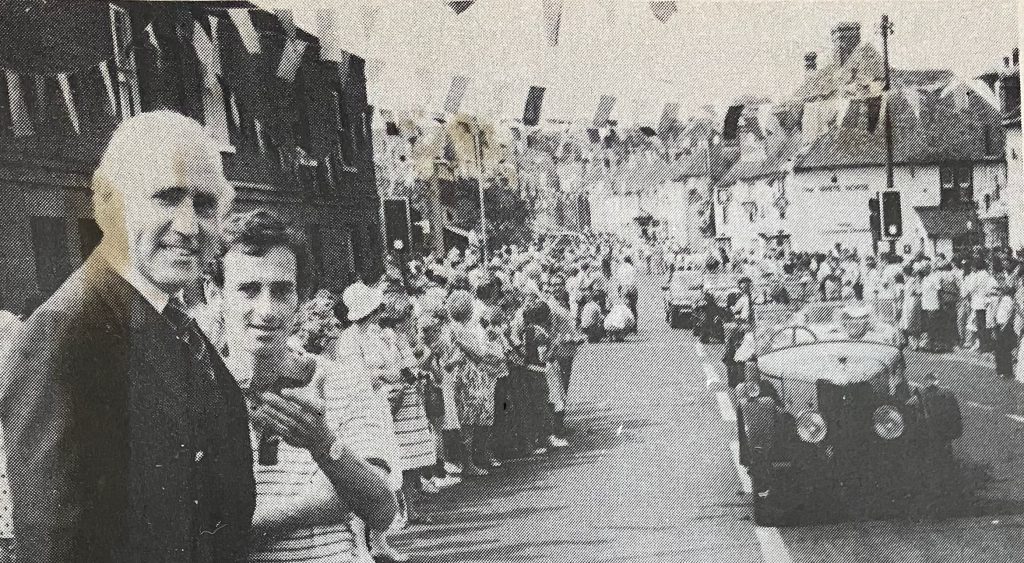
David Crouch and Brian Lewis at the Bridge Bonanza
In early July, Brian Lewis wrote to David Crouch and the County Surveyor warning that vehicles were still passing through Bridge at speed, and sure enough, two weeks later, Rosebank and The Ship on the High Street were hit by two cars involved in a collision. Rosebank had been the family home of John Purchese when he first launched the bypass campaign back in 1962.
On 8 September 1976, the Lower Harbledown bypass linking Rheims Way to the A2 was officially opened. The ceremony was boycotted by several villagers who had lobbied instead for a bypass around Canterbury.
The following year, on 18 February 1977, the Dover eastern bypass (Jubilee Way) was opened by Dover MP Peter Rees, and on 9 October 1981, the dual carriageway Canterbury bypass linking up with the Upper Harbledown and Bridge bypasses finally opened for traffic.
It would not be until 2 June 1987 that the grade-separated junction at Barham interchange was completed and the infamous crossroads eradicated.
In 2026, on the 50th anniversary of the opening of Bridge bypass, KCC approved a 20mph speed limit throughout Bridge and Patrixbourne, a limitation first proposed by the A2 Group in December 1972.