Within the space of just over a year, two major buildings in the historic city of Canterbury have gone up in flames. Both structures dated from the interwar period and both had been abandoned for several years. One was a former department store, slated for redevelopment, the other, a cinema closed down during the Covid pandemic and never reopened.
The former Debenhams store on Guildhall Street was set alight in December 2024, and a couple of teenagers were soon arrested for arson. The Odeon (originally the Regal) cinema on St George’s Place, just outside the city wall, burst into flames on Valentine’s Day 2026, prompting the evacuation of local residents. And once again, two teenagers have been arrested on suspicion of arson.
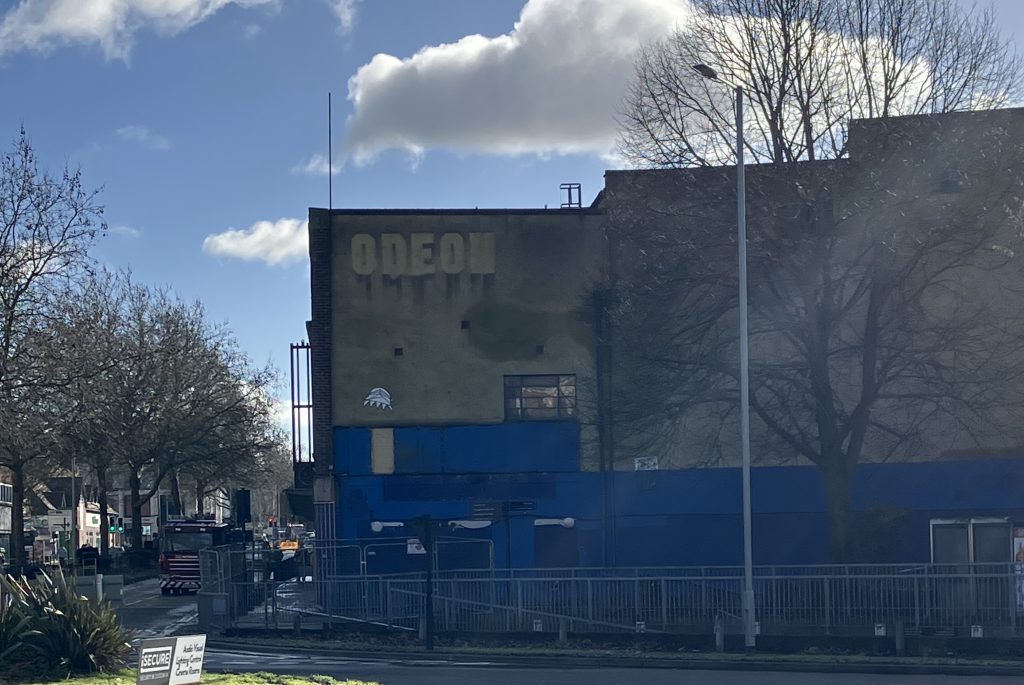
The Odeon in the immediate aftermath of the fire
While the fires might look suspicious, more interesting, I think, is what the conflagrations tell us about the sweeping changes to the urban landscape in England, and in particular the decline of the traditional high street.
The Regal Cinema opened in 1933 when movies were by far the most important source of mass entertainment. The imposing brick structure contained a multi-level auditorium with a remarkable 1,750 seating capacity, and a powerful organ to provide the movie soundtrack. Cinema attendance across the United Kingdom averaged around one billion each year during 1930s and reached a peak of 1.6 billion in 1946.
Attendance levels declined steadily thereafter and dropped off dramatically in the 1960s as television ownership expanded. The cinema in Canterbury responded by dividing the complex into two auditoria, with one dedicated to bingo, but even that was not enough. The introduction of home video rentals saw cinema attendance decline further, reaching an all-time low (excluding pandemic levels) of 54 million in 1984.
It was only after the industry switched to a multiplex model, with several much smaller screens giving operators more options and less risk, that attendance figures recovered to around 150 million a year. According to the Independent Cinema Office, the optimal configuration currently is one main screen of 150-250 seats and smaller, premium screens of 70-100 seats. The two new Curzon cinemas in Canterbury both have both adopted this approach with large, comfortable seats, and a food and beverage service. At a price, of course. Tickets are around £10, about one hundred times higher than in the 1950s when the average ticket price was two shillings.
The great British department store has followed a similar trajectory. The first department store opened in London in the late 18th century and by the late Victorian era, when the growing middle-class could sample an ever-expanding range of consumer goods, it had become an established feature of the urban landscape.
It was around this time that William Lefevre, the son of a Canterbury grocer, began developing his retail business empire. After serving an apprenticeship in London, William purchased a drapery shop adjacent to Canterbury cathedral on Sun Street in 1875. He then purchased several adjoining properties and by the time his son Charles took over the family business in the early 20th century, there was a clear economic imperative to combine their assets and create one big shopping paradise.
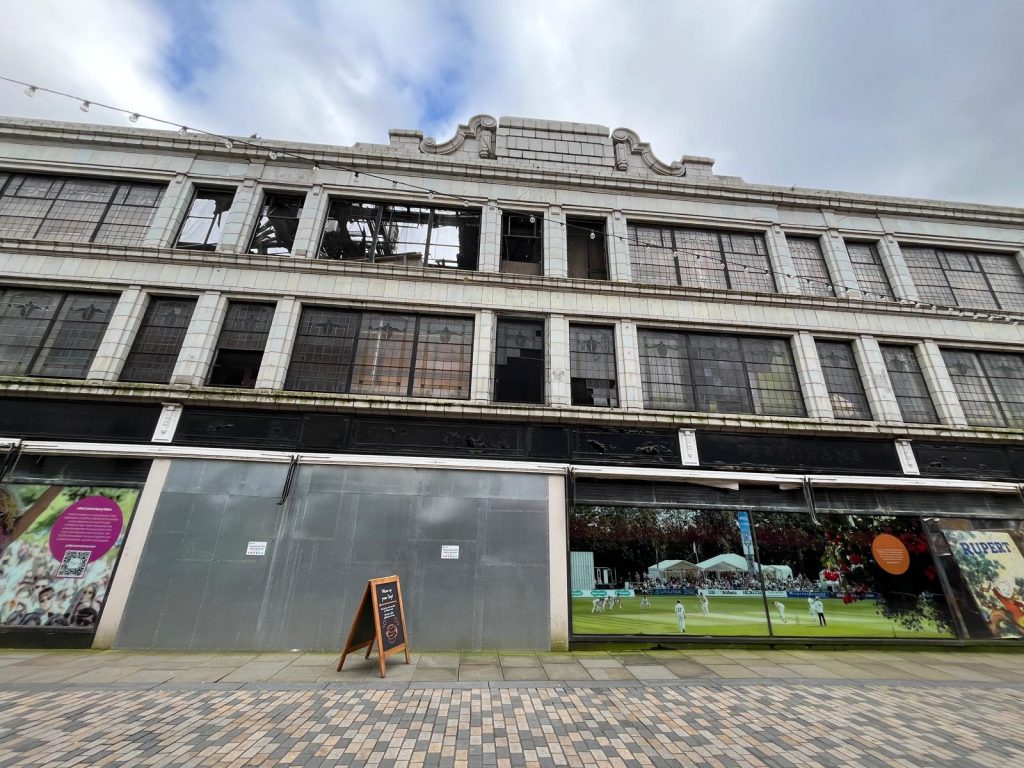
The abandoned Debenhams store on Guildhall Street
The concept of destination shopping was first devised by Selfridges in 1909, and the idea was soon taken up by other companies across England who built grand modernist and art-deco buildings that combined an array of retail outlets with dining and entertainment venues. In 1925, Charles Lefevre embarked on massive and controversial project to merge their Guildhall Street store with the adjacent Philosophical and Literary Institution and Museum, the Theatre Royal and the Guildhall Tavern. The resulting three-storey building occupied just about the entire length of Guildhall Street, with its main entrance on the High Street. Almost as soon as the store opened, the Lefevre family sold out to new investors, and the business was then acquired by Debenhams in 1927. The store was only rebranded as Debenhams in 1973.
There was one major drawback of the Guildhall Street complex that would only become apparent later in the 20th century. The lack of any car parking spaces was not a problem when public transport could effectively ferry customers to and from their destination but with the decline of the rail and bus networks and the rise of the car, customers looked for more vehicle-friendly options. The development of out-of-town shopping malls, that often-included multiplex cinemas, meant that the traditional department store’s days were numbered.
Debenhams closed its Canterbury store in 2020, and the company only exists today as an online shadow of its former self. Another family owned department store on the High Street, Nasons, closed in 2018, and there is just one purpose built department store left, Fenwicks, at the top of the High Street. Fenwicks opened in 2005 as part of the extensive new Whitefriars development. It was designed – much as new multiplex cinemas – with a wide variety of small-scale, branded outlets to diversify risk and maximise profit. So far, it has survived the rise of online shopping by moving up market and catering almost exclusively to the wealthier, elderly residents of the city.
There were plans to redevelop both Nasons and Debenhams into mixed-use residential and retail complexes. However, since 2020, all new developments that impact the River Stour, which runs through the centre of Canterbury, are being blocked by the government environmental agency Natural England, which is seeking to protect the nature reserve downstream in Stodmarsh. The reserve currently has excessively high levels of nitrogen and phosphorus from waste water discharge, and, so far, no one has come up with a suitable (affordable) water treatment scheme to mitigate the problem.
As a result, Canterbury High Street remains haunted by ghosts of entertainment and retail past. And the chances of another sudden conflagration cannot be ruled out.