On this day in 1793, a middle-aged widow wearing a simple white dress, her head shorn of her thinning grey hair, her hands bound behind her back, walked briskly up the steps to the guillotine. So eager was she to meet her fate that she accidently trod on the toes of her executioner. She apologised to him, and meekly embraced death, surrounded by hundreds of blood-thirsty Parisian onlookers.
Marie Antoinette had arrived in Paris twenty-three years earlier as the fifteen-year-old bride of the dauphin. She was greeted by the public as that “Austrian Bitch,” and would spend the next two decades as a hostage to European realpolitik, subject to continual accusations of extravagance, licentiousness, depravity, and treachery.
Should we feel sorry for Marie Antoinette? She was, after all, born into the wealthiest and most powerful family in central Europe, and spent nearly all her life cossetted and surrounded by luxury, blissfully unware of the struggles of the 99.999 percent outside her palace doors. Moreover, she never really questioned that this was the natural order of things. Even as the walls closed in during the French Revolution, and her prison became evermore confined, Marie Antoinette still clung to the belief that the established order would ride to her rescue and save her from the rabble who had taken over.
But, at a very human level, her life was tragic. As soon as she was born, Maria Antonia Josepha Joanna Habsburg became a pawn in her mother, the Empress Maria Teresa’s, grand European chess game. The empress’ many daughters were there to be married off to princes in faraway lands so that she could secure the alliances needed to bolster the family dynasty.
After lengthy negotiations with the court of Versailles, the soon to be Marie Antoinette, was literally trafficked by her mother across the border to France. Her husband in waiting (the future Louis XVI) was an overweight dullard, more interested in hunting and mending locks than paying any attention to his young bride.
This presented an immediate problem for Marie Antoinette whose job it was to produce an heir to the French throne and cement the alliance with Austria. She was constantly harangued by her mother to find a way to entice the dauphin but years went by before he worked up the energy to impregnate her. In fact, it needed a personal visit from Marie Antoinette’s brother, Emperor Joseph II, to cajole Louis into keeping his end of the marital bargain. It would be eight years after her wedding that she finally gave birth, first to a daughter, and then in 1781, to a son and heir.
All this inactivity furnished rumours that Louis XVI was impotent and that his wife must be getting satisfaction elsewhere. In a series scurrilous pamphlets, printed abroad and smuggled into France, Marie Antoinette was portrayed as lascivious and promiscuous woman, taking numerous lovers including the King’s brother and the ladies of the court, and performing a bewildering array of sex acts. She almost certainly did have an affair with the dashing Swedish army officer Count Ferson, but somehow that never made it into les libellés. Ferson remained lifelong friends with Marie Antoinette and was instrumental in organising the royal family’s Ill-fated flight from Paris on 20 June 1791.
The Queen was a great patron of the arts but even this was the subject of malicious gossip, particularly her championing of the brilliant violinist and composer, Chevalier de Saint-Georges Joseph Bologne, known as the “Black Mozart.”
Marie Antoinette is perhaps best known today for her love of luxury but she was probably no more extravagant than other members of the royal family and the court. In the infamous Diamond Necklace affair, later made famous by Alexandre Dumas, she was accused of coveting a particularly ostentatious piece of jewellery. In this, she was almost certainly a victim of a scam. She had no need of more diamonds, and certainly not the over-the-top creation originally intended for the mistress of Louis XV, Madame Du Barry.
Her widely mocked “rural retreat” of Le Petit Trianon was undoubtedly a fanciful indulgence but it was inspired by the philosopher Jean-Jacques Rousseau, who advocated a simple life, close to nature. It is also worth noting in passing that Marie Antoinette, unlike her corpulent husband, never drank alcohol and had little interest in the ridiculous rituals and banquets of Versailles.
On the count of treachery, however, there is solid grounds for conviction. But Marie Antoinette was in an impossible position. Her mother and brother wanted her to further Austrian interests at Versailles but as the Queen and mother of the young dauphin, she was duty bound to put the interests of France first.
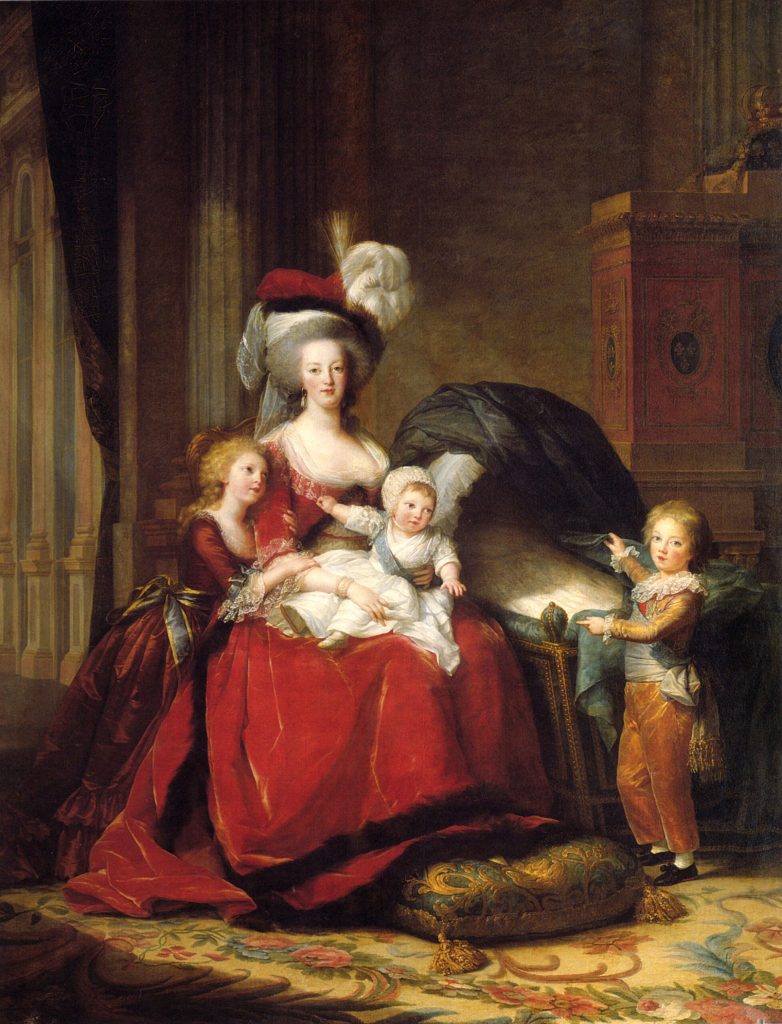
A portrait of the Queen and her children painted in 1787. The dauphin points to the empty cot formally occupied by his youngest sister. The dauphin would die soon afterwards.
During the revolution, she desperately sought to protect her family from the growing threats from the republicans. She had lost two children prior to the revolution, and was determined to ensure that her two surviving children remained safe. She had to act because her husband was too weak, indecisive and often paralysed by depression to do anything. Her actions were seen by republican leaders as a counter-revolutionary plot with foreign forces but Marie Antoinette was never really a political animal. Her overriding concern was simply the security of her immediate family. After the death of the king, she continued plotting in the hope of rescue but in the end, she was abandoned by the Habsburgs, and every other European royal family, leaving only a few, ill-equipped royal fanatics and the ever-devoted Count Fersen to offer assistance.
As all hope faded away, Marie Antoinette maintained a calm, dignified existence in prison despite continual humiliations and deprivations. On 3 September 1792, her favourite (and alleged lover), the princesse de Lamballe, was brutally murdered, her corpse mutilated, and her head paraded on a spike in front of the prison for “one last kiss” from the Queen.
Even during her excruciating show trial, where she was forced to listen to a raft of absurd fabrications concocted by rabid misogynists, she only lost her composure once, when she accused of sexually molesting her son. “If I have not replied,” she told the court, “it is because Nature itself refuses to respond to such a charge laid against a mother!” At this point, several women in the gallery, who were certainly no friends of the former queen, demanded a halt to the proceedings.
It is little wonder that, in the end, Marie Antoinette accepted death without a fight.