In September 1802, four of the five Wordsworth siblings, Richard, William, Dorothy and John, gathered in London for a financial planning meeting. There was good news and bad news. The good news was that the inheritance from their late father, withheld by his employer Lord Lonsdale for two decades, had finally been agreed and would amount to the not inconsiderable sum of £10,388. 6s. 8d.
The bad news was that John Wordsworth’s first business venture, captaining the East India Company vessel, the Earl of Abergavenny, to China had lost money. William and Dorothy had invested £350 in the scheme in the hope that the returns from their brother’s opium sales would set them up in their newly established home in Grasmere and allow the philosopher poet to write happily without ever worrying about money.
John was insistent that their inheritance be turned over to him as soon as the first tranche became available, so that he could pay off his debts and finance another voyage. William and Dorothy were understandably hesitant this time but the finance was arranged and John set off again on 20 June 1803. During the return voyage, the Earl of Abergavenny was involved in a skirmish with the French fleet off the coast of Malaysia, and Captain Wordsworth was rewarded with an additional £500 for his services.
This trip was clearly a success, and John Wordsworth started planning for a lucrative third voyage that, if everything went to plan, would make his fortune and allow him to retire (aged 34) with his siblings in his beloved Lake District.
The Earl of Abergavenny set off from Portsmouth on 1 February 1805 at the head of a convoy of East India Company vessels bound for Bengal (to pick up a cargo of opium) and then on to China. On 5 February, the ship ran aground off the Isle of Portland and eventually sank in Weymouth Bay. Of the 402 people on board, 263, including the captain, were drowned. The value of the cargo of silver bullion and porcelain was estimated at £20,000.
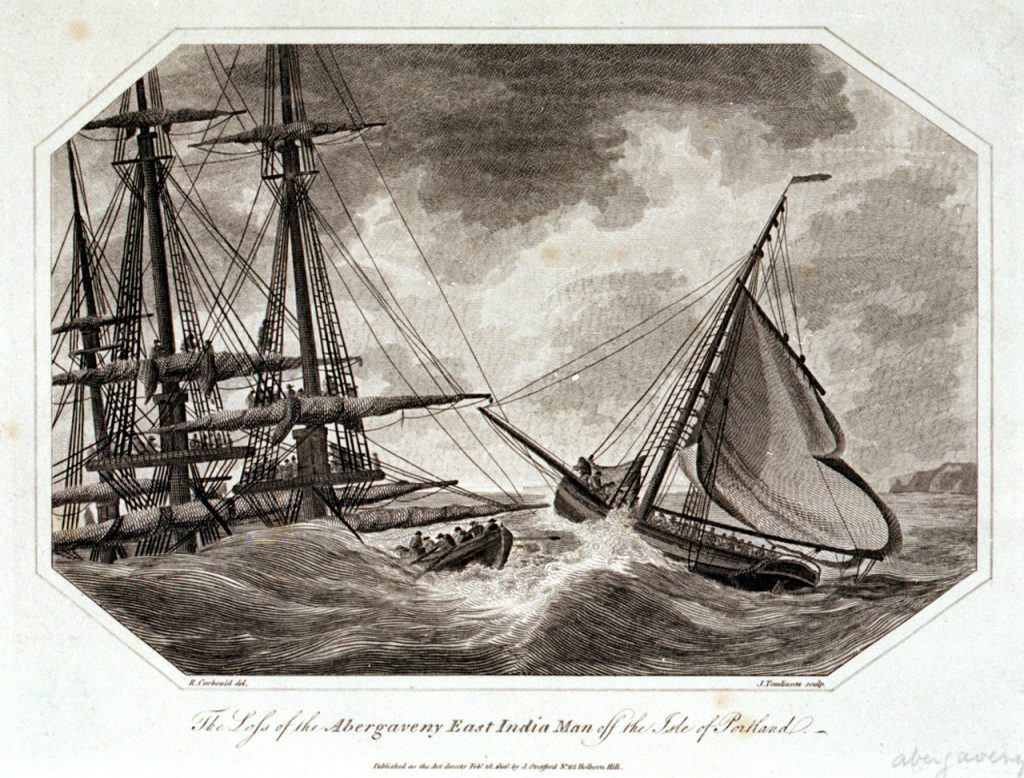
The Loss of the Abergaveny East India Man off The Isle of Portland. Monochrome print from an engraving by Richard Corbould. Courtesy the National Maritime Museum, Greenwich, London.
It did not take long for the finger of blame to be pointed at John Wordsworth, further distressing his devastated family. It seems that it was actually the pilot who was responsible for the grounding and that Captain Wordsworth heroically went down with the ship, clinging to the mast, having refused rescue.
There are so many questions raised by the tragedy of John Wordsworth, it is difficult to know where to begin. So, let’s begin with the opium trade. Much like the African slave trade, opium was a fundamental driver of the British empire in the 18th and early 19th centuries, leading to the establishment of Hong Kong as a key British colony. The East India Company financed its trade with China primarily by selling opium grown in India in exchange for tea and other commodities increasingly in demand in Britain. Needless to say, the Qing were not thrilled about this, and, in 1799, the newly enthroned Jiaqing Emperor (keen to make a name for himself after succeeding his much-vaunted father, the Qianlong Emperor) issued a decree banning the import of the drug outright.
The East India Company carried on regardless and even offered its ships’ captains a side-hustle, selling opium privately for their own profit. If they played their cards right, captains could earn up to £30,000 on one voyage. But it was a high-risk-high-reward proposition. The entire voyage lasted more than one year, and was fraught with danger from pirates, the tides and the weather, and dangerously fluctuating markets.
This is where John Wordsworth enters the picture. He got his start in the East India Company right after leaving school through his family connections (who included the anti-slavery campaigner William Wilberforce), and in 1801, he inherited the captaincy of the Abergavenny from his cousin, John Wordsworth Sr.
The younger John Wordsworth was not the archetypal ship’s captain. He was somewhat shy and introverted, known by his shipmates as “the philosopher,” he could often be seen pacing the deck absorbed in poetry. Nevertheless, he was a stern disciplinarian, handing out floggings to men under his command who violated discipline. It is said, he also wished to flog the men who on one occasion cut down trees in Grasmere, making him something of an eco-warrior before his famous elder brother got in on the act.
So, why was he willing to take such extraordinary risks for his own and his family’s enrichment? The Wordsworth children were orphaned at early age and tossed around between extended family members and surrogate parents until adulthood when they had to rely on themselves. The oldest brother Richard (again through family connections) embarked on a career as a lawyer, John joined the East India Company, and the youngest brother Christopher entered the church: all professions suitable for a gentleman.
But William was an artist. He couldn’t be bothered with minor things like where the next pay cheque was coming from. He never studied seriously at Cambridge and swanned off to France at the height of the revolution to better appreciate liberty and freedom. He had a brief affair with an older woman there, fathered a child and promptly abandoned mother and daughter.
Richard managed to keep his wayward sibling afloat the best he could but he was clearly exasperated at William’s indolence and self-absorption. Dorothy was a sycophantic enabler, and John it seems was equally spell-bound by his poet brother’s genius. In 1799, he offered William and Dorothy £40 for the purchase of land and a home in Grasmere but later decided that William’s generational talent was worth an even greater reward.
William clearly appreciated his brother’s devotion and kind nature. He wrote soon after John’s death: “Of all human beings whom I ever knew [John], was the man of the most rational desires, the most sedate habits, and the most perfect self-command.”
Without his brother’s promised riches, and a young family to support, Wordsworth should have knuckled down and focused on earning a living but he failed to secure any real income apart from his dwindling inheritance. He routinely refused to publish his work because it was not yet perfect or because publishers and critics did not properly appreciate its genius. And by 1808, even his number one fan, Dorothy was getting frustrated:
Do, dearest William! Do pluck up your Courage – overcome your disgust to publishing – It is but a little trouble, and all will be over, and we shall be wealthy, and at our ease for one year, at least.
In many ways, Dorothy’s life was just as tragic as John’s. We know from her journals and letters that Dorothy was a talented writer herself and that her literary observations clearly inspired William. If her talent had been nurtured in the same way that William’s had, Dorothy might have produced work on a par with her contemporary Mary Shelly, but Dorothy was devoted to her brother and subjugated all her ambition to his. She never married, and was his chief cheerleader and dedicated companion, even after his marriage to their childhood friend Mary Hutchinson.
In middle-age, Dorothy’ self-sacrifice finally caught up with her. She fell dangerously ill, was in constant pain, and addicted to opium. She remained at home for the next two decades, suffering from debilitating pain, eating disorders, and early onset dementia, which at times led to violent outbursts that would “terrify strangers to death.”
It was only in 1813, that William Wordsworth – aged 43 – in dire financial straits, with a wife, sister and three children to support (two of his young children had died the previous year), finally landed a “proper job.” Lord Lonsdale, the son of the man who had withheld his inheritance for so long, took pity on Lakeland’s resident poet and offered him a sinecure as Distributor of Stamps for the Westmorland and the Penrith area of Cumberland.
This gift, at last, provided Wordsworth and his family with some financial stability. This included Caroline, his long-neglected daughter in France who was about to be married. Wordsworth, at the insistence of his wife Mary, gave Caroline a generous annuity of £30 a year.
Wordsworth continued to write periodically, and gradually his audience grew beyond a tiny circle of die-hard fans, to win national and international acclaim as the Poet of the Lakes. He was still a grumpy old recluse but he did increasingly enjoy his celebrity status in fashionable society. However, his resistance to the publication of his most important work The Prelude continued, and it only appeared after his death, published by his widow in 1850, thus providing her with some financial security in her old age.
Recommended reading
Stephen Gill, William Wordsworth: A life, Clarendon Press, Oxford, 1989.
Althea Hayter, The Wreck of the Abergavenny, Macmillan, 2002.